


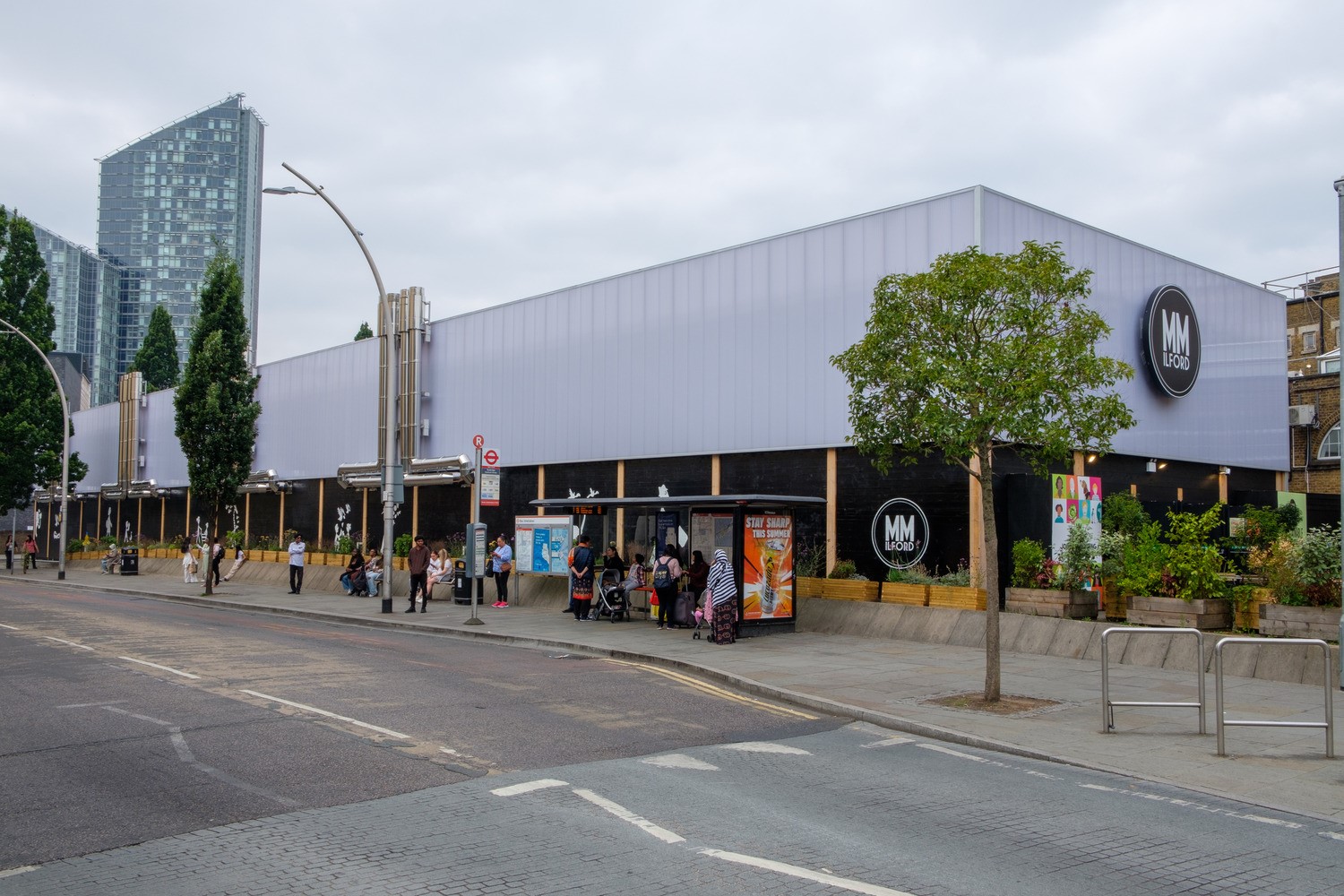
06 Mar Mercato Metropolitano Ilford
Project Summary
A sustainable new community food market for Ilford. Combining community events and circular practices, Mercato Metropolitan is much more than a food market — it is an urban destination and community space.
The project is supported by the GLA’s Good Growth Fund with Redbridge Council’s regeneration scheme, Spark Ilford, and will sit on a formerly neglected surface car park in Ilford town centre until 2029. With the temporary location in mind, the exposed timber structure is designed in flexible, re-deployable modules to accommodate its disassembly and reconfiguration on potential future ‘meanwhile’ sites.
Project Description
Situated at the rear of Redbridge Town Hall, the site was previously a surface car park. Beneath the car park are several subterranean tunnels that were constructed and used for air raid shelters during World War II. One of the core project philosophies was to return the site undamaged at the end of the lease period, leaving the car-park free from buried structures that would need to be removed for likely future development of the site.
At the very conception of the project, Mercato Metropolitano engaged the industry in a competitive design ‘charrette’, setting a challenge to create a sustainable market that could be relocated to a different site. The nature of the charette allowed for the quick development of ideas alongside the client and, by the end of the process, the concept of community farming, and maximising land use while eliminating intrusive foundations were adopted by the client. The original design team were appointed following their engagement in this workshop.
The project faced a number of challenges. The design planned for air raid shelter tunnels running beneath the site, but additional tunnels that weren’t documented and therefore were un-anticipated were discovered and limited the structure to one storey. Original plans included a hydroponic community farm under multi-span polytunnels on a second storey. Despite these setbacks, Mercato Metropolitano remained committed to delivering a valuable, sustainable space for Ilford and the final design retains its core principles.
A demountable timber frame reduces embodied carbon and keeps the material intensity of the foundations to a minimum, ensuring the site can be fully restored in the future and the market relocated elsewhere.
The building is clad with recyclable polycarbonate cladding as a quick and inexpensive way of letting in natural light, carefully detailed with simple mechanical fixings for easy maintenance and reusability. A modular layout of stalls gives flexibility with future tenants.
As with any food hall, a high turnover of trading partners with unknown requirements meant that extraction proposals for the cooking areas required particular focus. Local extraction is provided to all cooking zones, with the vents incorporated into the architecture through bold placement on the column gridlines. A centralised zero-landfill operation waste refuse area has been designed to focus on circular practices to reduce and reuse where possible. This includes oil separation, glass crushing, cardboard compaction, and an on-site aerobic digester that enables the rapid composting of food waste.
The design also facilitates sustainable additions down the line — now, instead of the hydroponic farm, the roof level has been designed to accommodate a community garden, and a mezzanine level, which occupies just under half the area of the L-shaped space, will be used to provide flexible community, event, and teaching space.
Now, more than 20 independent trading partners, many of them drawn from the surrounding area, are able to offer delicious artisanal food and dishes from around the world, focusing on locally sourced ingredients and sustainable farming practices.
The hub is a model for how sustainable urban markets can evolve, proving that meaningful regeneration is possible, even in the face of unexpected challenges.
Architect’s Statement
After having previously collaborated on their Elephant & Castle site, Clark Architecture were appointed at Stage 4 to support Mercato Metropolitano in moving forward with the project with construction planned to start on site late 2020. The team was determined to deliver the project for the community after the unavoidable disruption of the pandemic.
The building is essentially a covered market and therefore has no heating or cooling demand. It is open to the elements at the base of all facades and at the eaves to allow for fresh air circulation and stop the building overheating in the hotter months. Plastic reusable wind curtains can be installed in colder months to provide a sheltered lobby when required. The building is considered a ‘low energy demand’ equivalent building in AD L2.
Timber lends itself to reuse and was the natural choice for a sustainability-focused temporary community space. The building is formed from glulam columns and beams with CLT softwood infill panels at low level and polycarbonate cladding at high level. The roof is made up of softwood CLT slab covered with a single ply membrane. Internally, the language of the various kiosks, service, and centralised areas creates a cohesive feel through the use of standard sawn timber planking.
Like everything else, the acoustic fence was specified for its demountable properties. The internal face is clad in Quietstone light — a rigid, durable absorber made from 94% recycled expanded glass beads — while self-bearing panels are mechanically fixed direct to wall for easy maintenance and demountability.
The next phase of the project intends to unlock the multipurpose mezzanine space and create a community garden on the roof. Pre-planning applications for this next development have been discussed with the London Borough of Redbridge whose feedback was positive.
We’re looking forward to seeing the structure evolve to serve both its current and future communities.
— Anthony Clark, Director, Clark Architecture
Working Detail
Circular economy principles were central from the outset of the project.
Manufactured in Italy by X-Lam Dolomiti, a company well versed in offsite prefabrication of timber structures, the exposed engineered timber frame revolves around the principle of repeating standardised elements. This serves the dual purpose of reducing the initial construction time as well as allowing it to be easily moved and reconfigured without the need for additional bespoke elements or excessive waste. Due to travel restriction at the time, X-LAM handed over to UK-based companies B&K Hybrid Solutions and Oyster Design and Construction for erection of the frame. Which was delivered in eight loads to coincide with the assembly programme and for ‘yet to be used material’ to not cause obstructions on the site during the installation.
A unique plate test methodology was devised during early conversations to provide some information as to the performance of the installed foundations under load. Plate testing equipment was used to load the pads and mimic the loading of the proposed structure in attempt to show that the settlement encountered is within the limits allowed by the structural design, and again to develop the lifting plan and position of the mobile cranes around the site for the most efficient and safe assembly of the frame.
A flame-retardant impregnation treatment — a polymeric blend of organo-phosphate and nitrogen salts — was applied to the timber to achieve a class 0 rating.
The cladding and waterproofing were fixed in small sections so that repair and maintenance could be carried out in localised sections and not cause disproportionate replacement of materials. Panels are installed by means of panel coupling, provided by tongue and groove joints and aluminium fixing clips fixed back to a secondary structure.
— Anthony Clark, Director, Clark Architecture